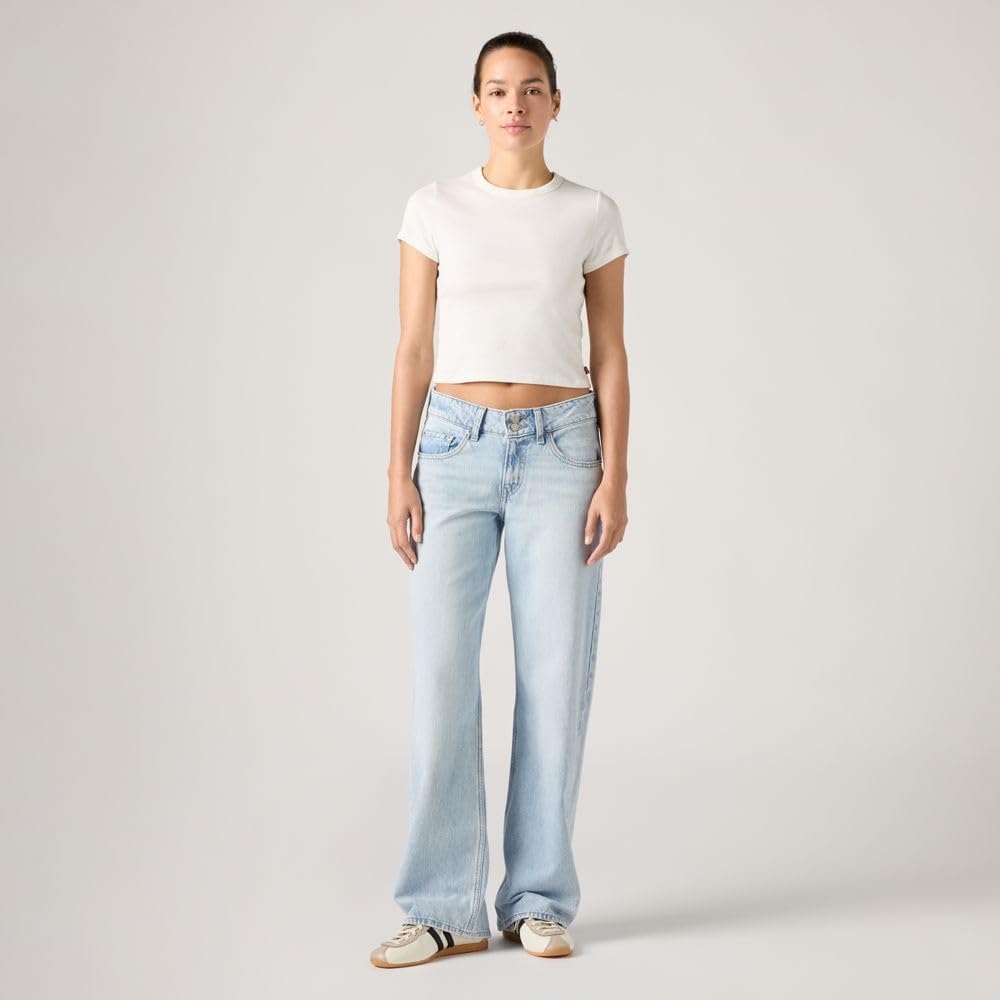
You know that moment when you see a pair of barrel jeans on the rack — that rounded, almost puffy-through-the-thigh silhouette — and you can’t tell whether they’ll look intentionally cool or just oversized-wrong? That moment of hesitation is what this guide is built to resolve. Barrel jeans are a specific cut where the leg is fuller from hip to knee and then tapers toward a narrower ankle, creating a curved or “barrel” shape. Y2K baggy fits (Y2K refers to the early-2000s aesthetic that’s cycling back hard right now) share that volume through the hip and thigh but tend to run straight or wide all the way to the hem. Both silhouettes sit low on the waist — meaning below the natural waist, closer to the hip bone — which changes everything about how proportions read on your body. This guide will walk you through exactly how these cuts interact with your measurements, where each tier of the market does them well, and how to stop second-guessing the cart.
Why Rise Is the Load-Bearing Variable (and Most Shoppers Ignore It)
Here’s the tradeoff nobody puts on the product page: low rise (generally defined as a front rise — the measurement from crotch seam to waistband top — of 8 to 10 inches) shifts the visual weight of a silhouette downward. When you combine that with added volume through the thigh, you’re working with a lot of real estate between waistband and knee. That zone is the entire game with barrel and baggy fits.
Heddels’ visual guide to denim rise makes this explicit: every inch of drop in front rise lengthens the visible torso above the waistband and simultaneously compresses the visual leg length below it. For petite proportions (under 5’4”), that compression can eat several inches of apparent inseam. For longer-torso proportions, the same drop can be genuinely flattering — it creates breathing room between the natural waist and the top of the jean, which reads as relaxed rather than sloppy.
The decision frame here is not “is low-rise flattering on me?” — that’s a false binary that Refinery29’s baggy jeans proportion guide has pushed back against consistently. The real question is: how much volume, and where? A mid-thigh barrel taper reads completely differently than a full-leg Y2K wide. Let’s map the differences before we get to specific pairs.
The Four Silhouette Subtypes You’re Actually Choosing Between
1. Short barrel — Volume concentrated between upper thigh and knee, narrow from knee down. Front rise typically 8.5–10 inches. This is the most forgiving of the four for petite frames because the taper hits above the calf.
2. Long barrel — Volume runs hip-to-below-knee before tapering. Often needs a hem. Works best when inseam is at or above 30 inches pre-alteration.
3. Y2K wide-leg — Straight-cut volume from hip to hem, low rise, often a slight flare at the very bottom. The silhouette that dominated 2001–2004 and is now the dominant shape at every price tier per Who What Wear’s 2025 trend coverage.
4. Y2K baggy straight — Wide through thigh, but not flared, cropped or full length. This is the workhorse of the category — the most brand-agnostic, the most available under $100, and the least polarizing.
By the Numbers: Rise and Thigh Measurements Across Tiers
| Cut / Brand | Front Rise | Thigh (size 28) | Retail Price |
|---|---|---|---|
| AGOLDE 90s Pinch Waist | ~9.5 in | ~26 in | ~$228 |
| Madewell Superwide Barrel | ~9 in | ~27 in | ~$148 |
| Frame Le Baggy Straight | ~10 in | ~25.5 in | ~$295 |
| Citizens of Humanity Horseshoe | ~9 in | ~27.5 in | ~$278 |
| Paige Noella Wide Leg | ~10.5 in | ~26 in | ~$259 |
Measurements sourced from brand size charts and aggregated owner-review consensus as of early 2026. Individual fit will vary by wash and fabric composition.
Proportion Matching: The “If X, Then Y” Decision Rules
This is where most buying guides wave their hands. Let’s be specific.
If your torso is short relative to your legs (you buy tops in XS/S but pants in a standard inseam): The low rise works in your favor — it reveals more torso, which can balance you visually. But avoid the long barrel; the taper hitting at mid-calf will shorten your leg line more than the revealed torso gains back. Go short barrel or Y2K baggy straight, and let the hem hit at the ankle or slightly above. Vogue’s 2024 barrel jean guide specifically flags the ankle-length hem as the proportion reset for shorter-waisted builds.
If your torso is long relative to your legs (you buy Longs or need to hem everything): Low rise compresses an already shorter visual leg. The fix is not to avoid the silhouette — it’s to manage hem length ruthlessly. A full-length Y2K wide leg that grazes the floor adds apparent height. Avoid the cropped barrel unless you’re pairing it with a heel that creates the leg extension artificially. Harper’s Bazaar’s barrel leg roundup for 2025 consistently recommends the longer-inseam option for long-torso frames, even if it requires tailoring.
If you carry volume in your hip and thigh naturally: The barrel and baggy silhouettes are genuinely not at odds with curvy proportions — but the thigh measurement is everything. The Citizens of Humanity Horseshoe (thigh ~27.5 inches in a 28 waist) is consistently flagged by owners in long-run reviews as the most generous through the thigh at this price point without sacrificing structure. A thigh measurement that’s too close to your actual thigh circumference in a non-stretch fabric will pull at the pocket seam and break the silhouette. The rule of thumb that surfaces across aggregated reviews: aim for at least 2 inches of ease (the difference between the jean’s thigh measurement and your actual thigh circumference) in a rigid or low-stretch denim.
If you’re petite and concerned about the “swallowed whole” effect: This is the most common hesitation The Cut surfaces in its low-rise coverage, and it’s solvable at the construction level, not just the styling level. Look for a front rise of 9–9.5 inches (not lower — 7 to 8 inches runs a genuine fit risk for most inseams under 29 inches) and a barrel taper that falls at or above the knee. The Madewell Superwide Barrel, at a ~9-inch rise and generous but not extreme thigh opening, is consistently cited by petite owners as a manageable entry point. Hem it to graze the ankle and you recover the leg length the low rise costs you.
Price Tier Breakdown: Where the Construction Actually Differs
Under $150 (Madewell, ASOS, Abercrombie): At this price point, the barrel or baggy silhouette is typically cut in a stretch-blended denim — 1 to 3% elastane is standard. That stretch is useful for fit insurance when you’re working with an unconventional silhouette, but it also means the fabric has less structure to hold the barrel shape over time. Owners report that stretch-heavy barrels at this tier tend to relax significantly after 5 to 10 wears, softening the taper. Not a dealbreaker, but manage expectations on silhouette longevity.
$150–$300 (AGOLDE, Frame, Paige, Citizens of Humanity): This is where the fabric conversation becomes worth having. AGOLDE’s 90s Pinch Waist is cut in a rigid-to-low-stretch denim (typically 0–1% elastane depending on wash) that holds the barrel shape through the thigh more persistently than stretch blends. Frame’s Le Baggy Straight at this tier is predominantly cut in Japanese or Italian milled denim, which per published spec comparisons offers tighter weave construction and more defined drape. The tradeoff: rigid or low-stretch means you need to size up if you’re between sizes, because there’s no fabric to meet you.
$300–$700+ (Rag & Bone, Citizens of Humanity Elysian, Japanese selvedge): At the collector and committed-enthusiast tier, the conversation shifts to loom provenance and weight. A barrel cut in 12–14oz selvedge denim (selvedge refers to a tightly finished edge on the fabric, produced on older shuttle looms, that prevents fraying and produces a distinctive “self-edge” on the outseam) behaves structurally differently than anything at lower price points. Denimhunters’ construction guides note that heavier-weight selvedge holds a pronounced barrel taper through extended wear far more reliably than ring-spun stretch blends. The functional cost-per-wear argument is real here: a $400 pair that holds its silhouette through 150+ wears mathematically competes with a $160 pair replaced every two years.
The Styling Variable That Proportion Guides Leave Out
Almost every proportion conversation focuses from the waistband down. The upper-half pairing is equally structural. Who What Wear’s Y2K denim coverage for 2025 identifies the dominant styling logic: a tucked or cropped top resets the waistline visually and counters the weight of the lower half. A long, untucked layer does the opposite — it erases the waist context entirely and lets the volume read as formless rather than intentional.
The practical rule: if you’re going low-rise barrel or wide-leg Y2K, your top hem should land within two inches of your waistband (either slightly tucked in, or cropped to sit just above it). This isn’t a style mandate — it’s a proportion math outcome. The low waistband needs a visual anchor above it or the silhouette loses its reference point.
The Decision Rule
Here’s the clean if/then frame for anyone currently sitting with a pair in the cart:
- If you’re under 5’4” and carry proportions in the hip: Short barrel, 9–9.5-inch rise, hem to ankle. Avoid long barrels and floor-length wides. Citizens Horseshoe or Madewell Superwide Barrel are the proportional anchors at each price point.
- If you have a long torso and want the Y2K wide: Go full-length or floor-grazing, not cropped. Spend on the hem alteration — it’s the single highest-ROI tailoring move in this silhouette.
- If you want the silhouette to hold its shape through heavy rotation: Step up to a low-stretch or rigid fabric. The AGOLDE 90s Pinch Waist at $228 or Citizens Horseshoe at $278 are the practitioner-tier entry points where construction actually delivers on the silhouette promise.
- If you’re buying as a wardrobe investment at $300+: Selvedge barrel constructions reward long-term ownership in a way stretch blends genuinely don’t. The fade potential and structural retention are meaningfully different, and the cost-per-wear math closes fast if you actually wear them.
The barrel and Y2K wide-leg moment isn’t a trend you need to chase — it’s a silhouette category that’s now wide enough to have a version calibrated to almost every proportion. The variable that matters most isn’t the brand or the price; it’s the rise measurement matched to your inseam, and the thigh ease matched to your actual thigh. Get those two numbers right before anything else, and the rest of the decision gets considerably simpler.