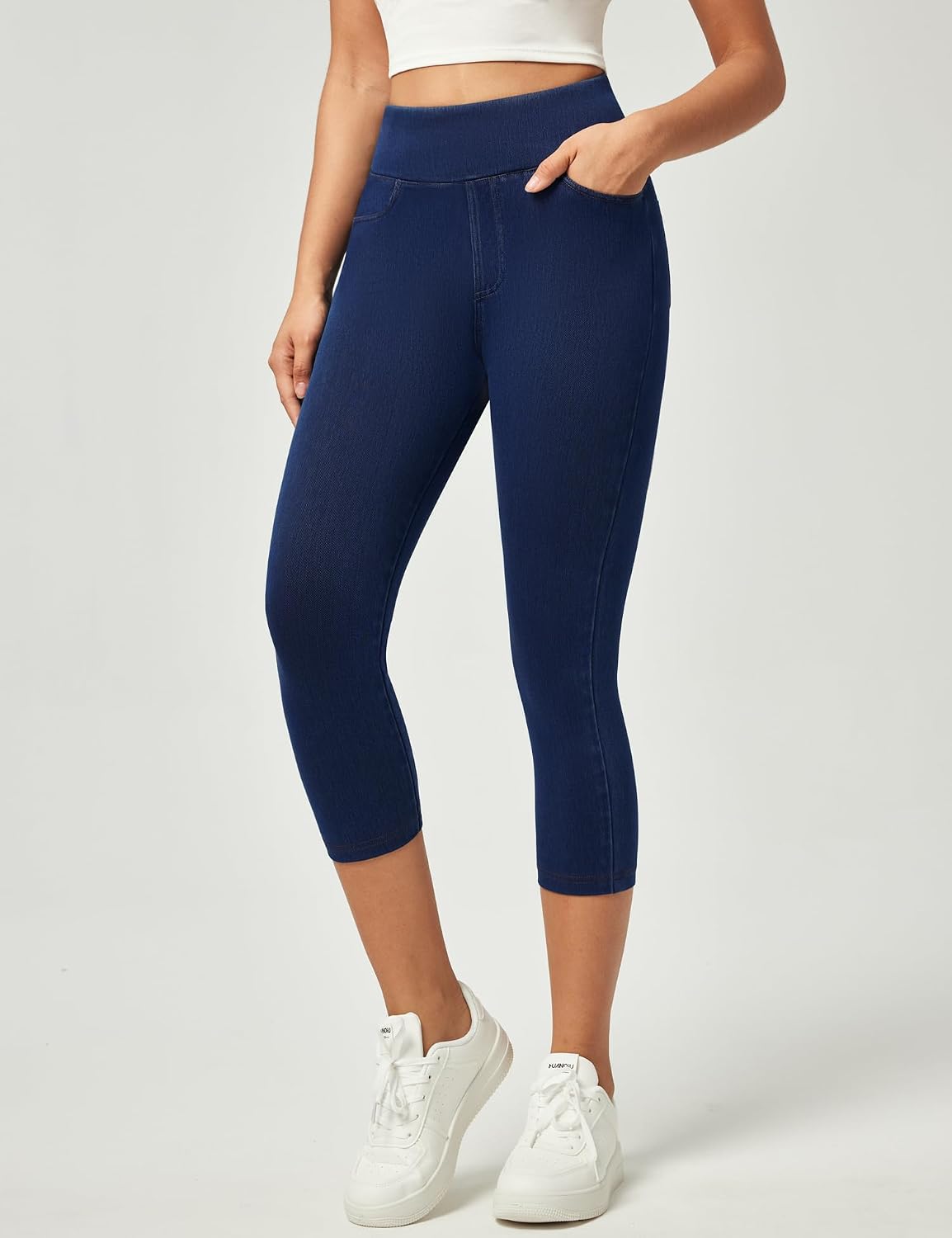
You know that moment when you find a pair of cropped jeans that look incredible on the model — ankle just peeking out, leg line clean and intentional — and then you try them on and the hem lands somewhere between your knee and your calf in a way that looks neither deliberate nor flattering? That’s not a style failure on your part. That’s an inseam-to-proportion mismatch, and it’s the single most common mistake in warm-weather denim buying.
Cropped jeans are any denim cut shorter than a standard full-length inseam (roughly 30–32 inches for most women). Capris are a specific subcategory that hits between mid-calf and just below the knee — typically an 18–23 inch inseam. Ankle crops land closer to 25–27 inches and graze the ankle or top of the foot. The difference between a cut that elongates your leg and one that visually shortens it often comes down to two or three inches of inseam — and whether that inseam aligns with a natural visual break point on your body. This guide gives you the formula to figure that out before you buy, so warm-weather denim shopping becomes a math problem with a known answer rather than a fitting-room lottery.
Why Inseam Alone Doesn’t Tell You Enough
If you’ve been shopping cropped denim for more than a season, you already know that a “24-inch inseam” on one brand can look completely different from a “24-inch inseam” on another. Part of that is rise variation — rise being the distance from the crotch seam to the waistband. A high-rise crop sits the hem lower on the leg than a low-rise cut with the same listed inseam, because the same 24 inches of leg fabric starts from a higher origin point on your body.
Heddels’ denim glossary makes this explicit: inseam measurement is taken from the crotch point to the hem, but where the crotch point falls on your body depends entirely on the rise. This means a 24-inch inseam on a high-rise frame (say, a 12-inch rise) places the hem very differently than a 24-inch inseam on a mid-rise cut (9–10 inch rise). When brands like AGOLDE publish their cropped measurements, they’re giving you one data point. The proportion formula requires a second: your own inseam, measured from your crotch seam to the floor.
The practitioner’s shortcut: Before evaluating any crop, calculate your personal “visual break zones” — the places on your leg where the eye naturally pauses and reads a hemline as deliberate rather than accidental. For most people these fall at three points: just above or below the knee (the calf-swell break), mid-calf (the widest point of the calf), and the ankle bone. A hem that lands at any of these points tends to shorten and widen the leg visually. A hem that lands between them — in the narrow corridor above or below each break — reads clean.
The Inseam-to-Proportion Formula, Step by Step
This is the framework stylists use that Who What Wear has summarized across multiple fit guides: match your hem to a visual narrow, not a visual wide.
Step 1: Measure your full inseam. Measure barefoot or in the heel height you plan to wear. This is your baseline number — call it I.
Step 2: Locate your break zones. Standing in front of a mirror, note the measurements (from crotch seam to floor) where:
- Your knee center falls (call this K)
- Your widest calf point falls (call this C)
- Your ankle bone falls (call this A)
Step 3: Apply the avoidance rule. Avoid hems that land within roughly 1 inch above or below K or C. These are your danger zones. Hems that land solidly between K and C (in the narrow upper-calf corridor, typically 2–4 inches below the knee) or between C and A (the lower-calf corridor, typically 2–4 inches above the ankle) read proportioned.
Step 4: Account for rise. Take the listed rise from the brand’s size chart. Add it to the listed inseam. The resulting number tells you the total crotch-to-hem distance and lets you sanity-check where the hem actually falls on your body. Subtract your rise-adjusted number from your floor measurement to see how much leg is exposed below the hem.
By the numbers:
| Your inseam (bare) | Flattering capri range | Flattering ankle crop range |
|---|---|---|
| 28 inches | 16–19 in inseam | 24–26 in inseam |
| 30 inches | 18–21 in inseam | 26–27 in inseam |
| 32 inches | 20–23 in inseam | 27–29 in inseam |
These ranges are derived from the proportion principle above: place the hem in a visual narrow corridor, not on a break point. They shift slightly depending on your individual calf width and ankle bone prominence, which is why the formula beats a flat chart every time.
Fabric Weight and Stretch: The Warm-Weather Variables
Here’s where the intermediate reader’s intuition gets tested. You can nail the inseam formula and still end up with a pair that feels like wearing upholstery in July. Warm-weather cropped denim is a fabric conversation as much as a fit one.
Stretch content matters differently in a crop. Because cropped jeans end at the calf or ankle rather than covering the full leg, they have less total fabric to manage body heat — but they also have less length to “grow” over the day. Stretch denim (containing 1–3% elastane or a lyocell-elastane blend) is notorious for elongating with wear, which means a hem that sits correctly at 9 a.m. may creep a half-inch lower by 3 p.m. In a full-length jean, that’s invisible. In a crop, it can push a clean mid-calf hem into calf-break territory.
Vogue’s warm-weather denim coverage has consistently flagged this: rigid or low-stretch denim (under 1% elastane, or stretch via warp-faced construction rather than added elastane) holds its hem length better across a wear day. If hem stability matters to your formula, look for stretch content disclosures on the product page — brands like Frame and Citizens of Humanity publish these, and the difference between a 2% and 0% elastane crop is measurable in how the hem drifts.
Fabric weight for heat management. Business of Fashion’s coverage of warm-weather denim trends notes a consistent market shift toward lighter-weight denim — typically 9–11 oz versus the 12–14 oz standard for year-round cuts. For cropped silhouettes, this matters: a 10 oz fabric drapes more fluidly at the hem, which tends to flatter the lower calf and ankle exposure more than a stiff heavier weight that can bow outward at a cropped hem.
For readers shopping in the $150–$400 range, here’s the practical split:
- Frame Le Crop Mini Boot and similar: Typically 10–11 oz denim with moderate stretch. Owners across review aggregators consistently describe the hem as stable across a wear day — that lower stretch content is the likely reason.
- AGOLDE 90s Crop: Rigid or near-rigid construction (reviewers frequently note the “raw” feel). No hem drift. Ideal if the formula gives you a narrow target zone.
- Paige Hoxton Crop and related: Higher stretch content means more comfort but also more hem movement. Size up on caution if you’re near a break zone.
Footwear and the Visual-Line Extension Principle
Harper’s Bazaar’s proportion-dressing guides make a point that’s directly relevant here: footwear color relative to hem placement can functionally shift where the eye reads the inseam endpoint. A shoe that matches your skin tone (nude to your actual skin, not a generic beige) extends the leg line visually below the hem. A shoe that creates a strong contrast — white sneaker against tan leg, dark sandal against pale leg — emphasizes the hem as a stopping point.
This isn’t a workaround for a badly-fitting crop. If the hem lands on your calf’s widest point, no shoe color fixes that. But at the margin — when the formula puts you in a choice between two inseam options — footwear intent is a legitimate tiebreaker. Planning to live in white sneakers this summer? Lean toward the longer option in the formula’s acceptable range. Wearing strappy sandals? The shorter end of the range often reads cleaner.
If X, Then Y: The Decision Rules
You’ve measured. You’ve run the formula. Here’s how to close the decision.
If your target inseam puts you exactly at a break zone (within 1 inch of K or C): Go longer. The formula’s “flattering range” has a safety bias toward longer cuts, because a hem that falls clearly between breaks is almost always more forgiving than one that grazes a visual wide. Size down one inseam option.
If you’re between two inseam options and wearing mostly flat shoes: Choose the shorter. Flat footwear naturally shortens the visual leg line; the slightly shorter crop compensates.
If you’re between two inseam options and wearing heels or platform sandals: Choose the longer. The heel already extends the leg; the longer crop won’t feel truncated.
If the fabric has more than 1.5% elastane: Factor in a half-inch of hem drift over a wear day and treat your target inseam as if it’s 0.5 inches longer. Compensate by selecting the shorter option in your acceptable range.
If you’re 5’4” or under and shopping standard (non-petite) sizing: Run the formula first — don’t assume petite is always the right call. Many standard inseam crops in the 23–25 inch range land in a flattering zone for shorter inseams without requiring petite sizing. Petite cuts often also shorten the rise, which can affect waistband fit independently of hem placement. Check both measurements before defaulting.
If you’re 5’9” or over and shopping standard sizing: The formula’s upper boundary (29-inch inseam in a “crop”) may functionally look like a full ankle-length jean on your frame. That’s not wrong — it just means your warm-weather crop strategy may lean toward ankle-length rather than mid-calf. Work from your personal A (ankle bone) measurement, not the brand’s “cropped” label.
The formula doesn’t change by price tier. A $60 Madewell crop and a $380 Citizens of Humanity crop are both subject to the same proportion physics. What the higher price buys you is more reliable published specs, tighter construction tolerances, and fabric weights that behave more predictably across a wear day — all of which make the formula easier to apply accurately. But the math is the math. Measure once, shop with confidence.