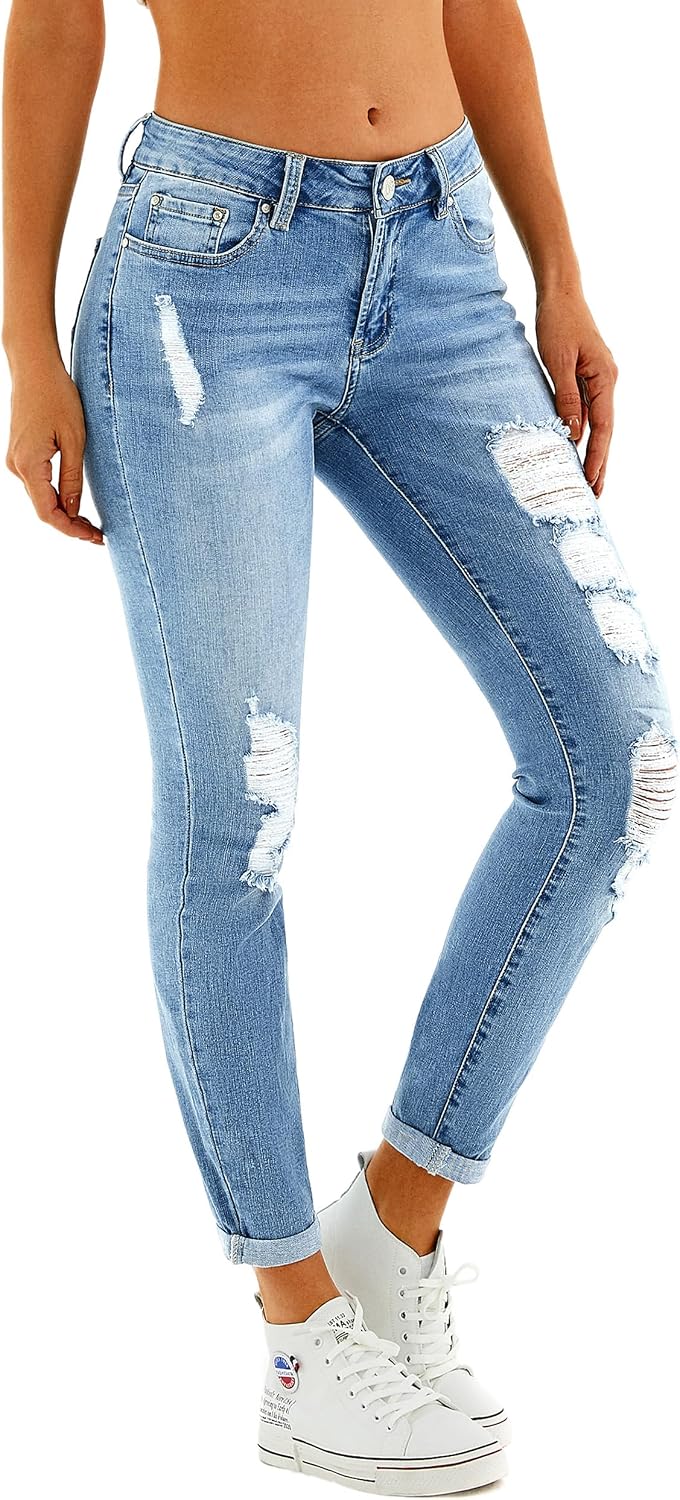
You know that feeling when you find the perfect pair of ripped jeans — the kind with that effortless, broken-in look — and then three washes later the knee hole has migrated halfway up your thigh? That’s not bad luck. That’s a construction problem, and it’s almost always visible before you buy if you know what to look for.
Distressed denim is exactly what it sounds like: jeans that have been intentionally abraded, torn, frayed, or faded during manufacturing to mimic the wear patterns that develop naturally over years of use. Done well, it’s a craft. Done cheaply, it’s a liability. This guide is for the reader who already knows their inseam, has opinions about rise height, and is now trying to level up the part of denim shopping that gets almost no editorial coverage: figuring out whether those artfully shredded knees will still look intentional in eighteen months — or whether they’ll look like an accident by June.
Why Distressing Method Is the First Thing to Evaluate
The single biggest quality dividing line in distressed denim is how the damage was made. There are three main approaches, and they produce dramatically different longevity outcomes.
Laser distressing uses a calibrated laser to ablate (remove) surface fibers without cutting through the weave structure underneath. The result is controlled, repeatable, and structurally stable. Reviewers at Heddels, in their complete guide to denim construction, describe laser finishing as the method most likely to produce distressing that holds its shape over repeated washing because the warp and weft threads (the interlocked vertical and horizontal yarns that form the fabric’s grid) remain mostly intact. Brands like AGOLDE and Frame use laser finishing at various points in their distressing process, and owners consistently report that the abraded areas don’t widen significantly with wear.
Sandblasting and hand-sanding are older techniques that physically abrade the surface. Hand-sanding done carefully by skilled workers — the way Citizens of Humanity and Rag & Bone approach their distressed lines — produces a more organic, less mechanically uniform result. The tradeoff: consistency varies by worker and batch. Per Business of Fashion’s reporting on how distressed denim is manufactured, hand-sanding is also considerably more labor-intensive, which is one real reason why a $400 pair from a brand with artisanal finishing processes costs what it does.
Raw cutting and fraying is the simplest method: fabric is cut and the threads are pulled or left to ravel. This is where the widening-hole problem most often originates. Without a structural intervention at the cut edge — a process called chainstitch bartacking (a reinforcing stitch that anchors the edge of the damage and prevents the weave from unraveling further) — a raw cut hole has nothing stopping it from growing every time the fabric flexes or goes through a spin cycle.
The fast check at the rack: Flip the jeans inside out. Look at the back of any ripped or abraded area. You should see either:
- A mesh backing or fusible interfacing bonded to the interior (common in mass-market brands, functional but not invisible)
- Tight, dense chainstitch bartacking at the termination points of any slit or tear
- In higher-end construction, visible hand-stitching or selvage-edge reinforcement
If you see raw, loose threads with nothing anchoring them on the interior, the hole will grow. That’s not a guess — it’s physics.
Fabric Weight and Stretch Content: The Math That Actually Matters
Here’s where the intermediate buyer can get a real edge over someone just reading the hang tag.
Distressing removes fiber. That’s the point. But if a fabric starts thin, distressing can take it past the threshold where it has structural integrity under normal movement stress. The relevant metric is fabric weight, typically expressed in ounces per square yard (oz/yd²) — the heavier the number, the more substantial the denim.
By the numbers: distressing vs. fabric weight
| Starting Fabric Weight | Distressing Risk Level | What to Watch For |
|---|---|---|
| Under 10 oz | High | Even light abrasion can compromise structure; holes widen fast |
| 10–12 oz | Moderate | Standard for most mid-tier stretch denim; adequate with good finishing |
| 12–14 oz | Low–Moderate | Common in premium non-stretch and selvedge; distressing holds shape well |
| 14+ oz | Low | Heritage and raw selvedge weights; distressing ages predictably |
Most spec sheets for brands like Paige and AG Adriano Goldschmied list fabric weight; if a brand won’t disclose it, that’s a signal. Denim Hunters, in their overview of selvedge and raw denim finishing, note that fabric weight above 12 oz is the threshold where distressing starts to behave predictably over the long term — meaning the damage you see at purchase is approximately the damage you’ll have in two years, not the starting point of a progression.
Stretch content complicates this. Elastane (commonly called Lycra or spandex — the same fiber, different brand names) adds recovery and comfort but reduces the fabric’s resistance to further tearing at distressed edges. Refinery29’s analysis of why cheap ripped jeans fall apart faster flags high-elastane blends (anything over 3% elastane) combined with raw-edge distressing as a particularly risky combination. If you’re buying a stretch-heavy pair with rips, the bartacking and interior reinforcement become even more critical, not less.
The practical rule: for a pair under $100, assume the distressing was laser-done or cut without significant interior reinforcement and budget for a shorter lifespan. For a pair at $200+, you have the right to look for — and ask about — the specific finishing method.
Reading Fade and Whisker Patterns as Authenticity Proxies
This section matters because fade patterns tell you something about the brand’s process integrity — which usually correlates with overall construction quality.
Whiskers are the radiating crease lines at the hips and upper thighs that develop from natural wear as the fabric folds in the same place repeatedly. On a well-made pair, manufactured whiskers are subtle, directional, and consistent with how the jean sits on a body. On a poorly executed pair, they look stamped or uniformly horizontal — because they were applied by machine without accounting for the garment’s three-dimensional shape.
Who What Wear’s 2025 distressed jeans ranking, based on aggregated owner reviews, consistently flagged this as the tell reviewers found most reliable at the point of purchase: whiskers that don’t align with the natural crease points of the hip and thigh are a sign that distressing was applied to flat fabric before the garment was assembled, which is the faster and cheaper method. Brands investing in quality typically sand or abrade after the garment is constructed or use 3D mannequin finishing to ensure the distressing conforms to actual body geometry.
Fade gradients follow the same logic. A quality fade looks like it came from sun, wear, and washing — concentrated at raised points of the fabric (belt loops, pocket edges, knee caps) and fading toward recessed areas. A budget fade is often uniformly applied and looks the same front-to-back. Run your fingers across the surface: on a well-faded pair, you can feel the slight texture difference between faded and unfaded areas because actual fiber has been removed. On a surface-printed fade, the texture is uniform and the color difference is cosmetic.
The If-Then Decision Framework: How to Use These Signals
You’ve got a pair in your hands — or you’re looking at product photos and a spec sheet. Here’s how to run the evaluation:
If the fabric weight is under 10 oz and the distressing includes raw-edge cuts with no visible interior reinforcement → pass unless the price reflects the disposability (sub-$60 is honest; $150 for that construction is not).
If the fabric weight is 10–12 oz, the brand lists elastane between 1–2%, and you can see bartacking on the interior at distressed termination points → this is a reasonable $100–$200 buy with normal care expectations. Machine wash cold, air dry, and the distressing should stay stable for 50+ wears.
If the fabric weight is 12 oz+, the distressing is described as laser-finished or hand-sanded post-construction, and the brand has a published spec sheet you can actually read → this is your $200–$400 tier and the cost-per-wear math works if you’ll wear them 100+ times. Citizens of Humanity and Frame consistently receive owner reviews confirming that distressing stays put over long wear cycles at this construction level.
If you’re looking at a selvedge pair with distressing — which is relatively rare but exists, particularly from some Japanese heritage producers — the warp threads are tightly spun enough that distressing tends to produce a very controlled, slow-to-evolve aesthetic. Heddels’ construction guide notes that selvedge’s tighter weave structure actually makes it more resistant to uncontrolled fraying than open-end spun denim of the same weight. The distressing will look almost exactly the same in three years as it does today, for better or worse.
If you’re buying as a gift or investment piece and can’t physically inspect the garment → prioritize brands with transparent spec sheets and documented finishing processes. Frame, Citizens of Humanity, and AGOLDE all publish enough product detail that you can make this call from a product page. Brands that describe distressing only as “vintage-inspired finishing” without elaboration are asking you to trust rather than verify.
One final signal that cuts across all tiers: look at the pocket bags (the fabric lining inside the front pockets). On a well-constructed pair, the pocket fabric is securely attached and the seams near the distressed areas are reinforced. On a lower-quality pair, the pocket bag fabric is sometimes the only thing holding a distressed knee area together — and it’s not designed for that job.
Distressed denim rewards the buyer who looks past the aesthetic and asks a simple structural question: was this made to look broken, or was it made to stay that way? The construction details answer that question before you ever get to the register.