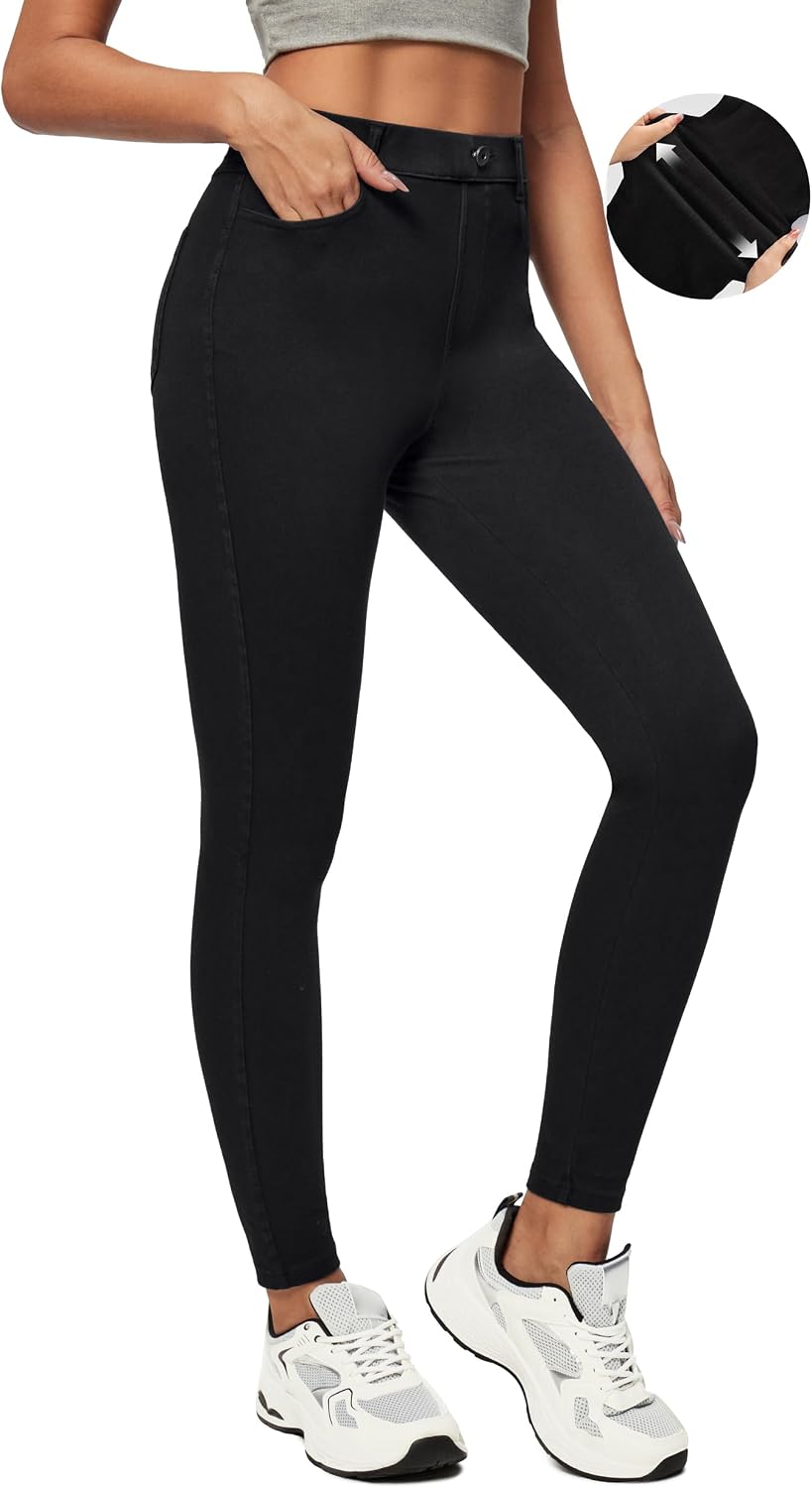
You know that feeling when you try on a pair of jeans, they fit beautifully, and then you sit down — and suddenly you’re negotiating with your own waistband? That’s the exact problem pull-on denim was invented to solve. Pull-on jeans (also called elastic-waist jeans) are cut like traditional jeans in the leg but swap the zip fly and button closure for a stretchy, elasticized waistband — no hardware, no fuss. Jeggings take that concept further: they’re typically made from a fabric that’s more legging than denim, printed or woven to look like jeans while feeling closer to athletic wear. Both categories have exploded over the past five years as workwear lines blurred and “all-day comfort” became a serious design brief rather than a compromise. But here’s where it gets complicated: the comfort-to-quality spectrum inside these two categories is enormous. A $28 fast-fashion jegging and a $195 AGOLDE pull-on are technically the same category of garment, but they’re different animals in fabric construction, longevity, and how they hold their shape after twenty washes. This guide is for readers who already understand why that gap exists — and want a decision framework for where to spend.
| EDITOR'S PICK[IUGA Wide Leg Jeans Woman High…](https://www.amazon.com/dp/B0DT3NX5RX?tag=greenflower20-20) | Mid-tier[GRAPENT Skinny Jeans for Women…](https://www.amazon.com/dp/B0F9FHN7YY?tag=greenflower20-20) | Budget pickAmazon Essentials Women's Pull-… | |
|---|---|---|---|
| Style | Wide Leg / Baggy | Skinny | Jegging / Knit |
| Rise | High Waisted | High Waist | Mid Rise |
| Material | Denim (stretchy) | Denim (stretchy) | Knit (stretchy) |
| Fit | Baggy / Straight | Slimming | Pull-on |
| Size Range | Petite | — | Plus Size |
| Color | Dark Blue | Medium Dark Blue | Black |
| Price | $25.64 | $20.99 | $12.06 |
| See on Amazon → | See on Amazon → | See on Amazon → |
The Fabric Divide: What’s Actually Inside the Waistband
If you’ve spent any time comparing stretch denim specs, you know that elastane content (also called spandex or Lycra — all trade names for the same synthetic elastic fiber) is both the magic ingredient and the reliability wildcard in pull-on denim. The question is how much, and what it’s blended with.
Heddels’ denim dictionary notes that traditional rigid denim contains zero elastane, while most commercial stretch jeans run between 1% and 4% elastane blended into a cotton or cotton-poly base. Pull-on jeans push that number higher — typically 5–12% elastane — to provide the waistband flex and recovery they’re designed for. Jeggings often go further still, with some running 30–60% synthetic content in a fabric that’s closer to ponte or scuba than to woven denim.
Why does this matter for durability? Per Denimhunters’ analysis of stretch denim construction, elastane fibers begin to break down with repeated heat exposure — machine washing and drying cycles are the main culprit. A fabric with 2% elastane in a 12-oz cotton base loses elasticity slowly over years. A fabric with 50% polyester and 20% elastane may lose its recovery tension within 18–24 months of regular wear, leading to the dreaded “bagging out” at the knees and seat that owners of cheaper jeggings consistently report in long-run reviews.
The thread count and weave matter too. True pull-on jeans from mid-tier and premium brands like AGOLDE or Paige use a woven denim construction — the fabric is actually woven on a loom, just with elastane spun into the yarn. Jeggings more often use a knit construction, which means the fabric is looped rather than woven, giving more stretch in all directions but significantly less structural integrity under stress points like the inner thigh. Who What Wear’s roundup of pull-on jeans for 2025 flagged this distinction explicitly: reviewers consistently rated woven-construction pull-ons higher for longevity than knit-based options at similar price points.
The Quality Tiers, Named and Compared
Here’s the honest breakdown by price tier, based on published specs and aggregated owner-review consensus:
By the numbers — elastane content vs. construction type by tier:
| Tier | Price Range | Typical Elastane | Construction | Expected Wear Life |
|---|---|---|---|---|
| Entry (fast fashion) | $20–$55 | 15–60% | Knit / ponte | 12–24 months |
| Mid-tier (e.g., Madewell, Liverpool) | $60–$130 | 5–12% | Woven denim | 3–5 years |
| Premium (e.g., AGOLDE, Paige, Frame) | $140–$260 | 2–8% | Woven denim | 5–8+ years |
| Designer / heritage | $280+ | 1–4% | Woven, sometimes selvedge | 8–15+ years |
Refinery29’s comparison of jeggings versus jeans noted that the true differentiator at entry price points isn’t elastane percentage alone — it’s whether the waistband elastic is stitched into a separate waistband panel (more durable) or whether the entire fabric panel is expected to function as the waistband (less durable). The latter construction is almost universal in sub-$40 options and is the single biggest predictor of early failure.
Mid-tier is where the calculus gets interesting. Brands like Liverpool Los Angeles and Madewell’s pull-on straight (reviewers at Who What Wear and Refinery29 consistently return to both) use woven denim with a bonded elastic waistband insert — the jeans look completely clean from the outside, with no gathered elastic showing, but the interior has a structured band sewn to a denim shell. Owners report these hold shape through 50+ wash cycles, which at two wears between washes represents roughly two years of weekly use before any notable stretch-out.
At the premium tier, AGOLDE’s pull-on crop and Paige’s Laguna pull-on represent the current standard-bearers. Published fabric specs on AGOLDE’s pull-on crop put the elastane content at approximately 3–5% in a 9–10 oz woven cotton base — lean enough to maintain the visual weight and drape of real denim while providing the waist flexibility the category requires. Owners across aggregated reviews consistently report these feel indistinguishable from a well-fitted regular jean when worn, with the pull-on feature serving as a convenience feature rather than a structural compromise. The price premium — typically $185–$220 compared to $75–$110 for the mid-tier — buys you construction quality, denim weight, and significantly better fade behavior over time.
The Tradeoffs No One Names Up Front
If you’re currently deciding between a $90 mid-tier pull-on and a $195 premium option, here are the tradeoffs worth naming explicitly:
Comfort ceiling vs. structure. Higher elastane content feels better on day one. Lower elastane content looks better on day three hundred. The mid-tier sweet spot — 5–10% elastane in woven denim — is genuinely good on both axes. Pure jeggings (high synthetic content, knit construction) win the first-day comfort test and lose the six-month shape retention test. Business of Fashion’s 2024 investigation into stretch denim’s durability problem cited multiple brand sources confirming that elastane degradation is nonlinear — fabric integrity holds relatively stable for the first 12–18 months, then declines sharply, which is why many jegging owners report a sudden “they just fell apart” experience rather than a gradual decline.
Waistband design signals quality tier. This is the fastest physical shortcut when shopping in-store or evaluating online photos: look at the interior waistband. A clean, flat interior band with visible seam stitching (often with a logo on a woven label) indicates a structured insert. A gathered, ruched, or uniformly stretchy interior with no separate band panel indicates a full-fabric stretch construction. The latter is not automatically bad — it can be appropriate at the entry tier — but it should inform your longevity expectations.
The styling constraint. Jeggings are harder to dress up credibly because the fabric weight and sheen read differently from true denim. This isn’t snobbery — it’s a practical styling consideration. True woven pull-on jeans in mid-to-premium tiers can be styled identically to their button-fly counterparts, which expands their cost-per-wear case considerably. A jegging worn to a casual dinner reads differently than a well-weighted AGOLDE pull-on at the same occasion. Refinery29’s readers consistently flagged this in crowdsourced style feedback: the “does this look like I’m wearing leggings?” anxiety is almost entirely absent with woven-construction pull-ons above the mid-tier.
The fit variability problem. Because pull-on denim lacks the structural anchors of a button fly and belt loops designed to bear weight, fit is more body-proportion-sensitive than in traditional jeans. Specifically: a rise that’s even slightly too long will fold over at the front, creating a visual line that no amount of styling fixes. Who What Wear’s guide to pull-on jeans recommends prioritizing rise measurement even more carefully than waist measurement when sizing pull-ons — the waistband accommodates a range, but the rise is fixed, and a high rise on a shorter torso will always fold. Published size charts for AGOLDE and Paige both include rise measurements by size, and owners report these are accurate to within a quarter inch.
The Decision Framework: If X, Then Y
Here’s the honest if-then map for the most common decision scenarios:
If you need pull-on ease for travel or all-day professional wear, and you’re buying one pair to own well: invest at the mid-to-premium tier (AGOLDE, Paige, or Frame pull-on options in the $150–$220 range). The cost-per-wear math favors these over a $45 option if you’re wearing them more than twice a week — at 150 annual wears over four years, a $195 pair costs $0.33 per wear versus a $45 pair that degrades significantly within 18 months at a higher effective per-wear rate.
If you’re testing the category for the first time and aren’t sure pull-on construction works for your body: start with a mid-tier option ($75–$110) from a brand with a strong return policy. Madewell’s pull-on straight and Liverpool’s pull-on are consistently cited in Who What Wear and Refinery29 roundups as reliable category introductions without full premium investment.
If you want maximum comfort for low-stakes daily wear and longevity isn’t the priority: a well-constructed mid-tier jegging from a brand with consistent size grading (not fast fashion, but accessible — think $40–$65) is a rational choice. Know going in that you’re buying a 12–24-month garment, not a wardrobe investment.
If you’re building a considered denim wardrobe and already own premium straight or skinny cuts: a pull-on option at the premium tier rounds out the collection without compromising your standards. The AGOLDE pull-on crop in particular reviews consistently as the “I forgot I’m not wearing real jeans” option — which, for a category that started as a comfort compromise, is the highest possible endorsement.
The bottom line is that pull-on denim has genuinely closed the quality gap over the past decade, but jeggings — high-elastane, knit-construction options — largely have not. Knowing which category you’re actually evaluating, and what the construction signals tell you before you commit, is the difference between a smart convenience purchase and a frustrating one.