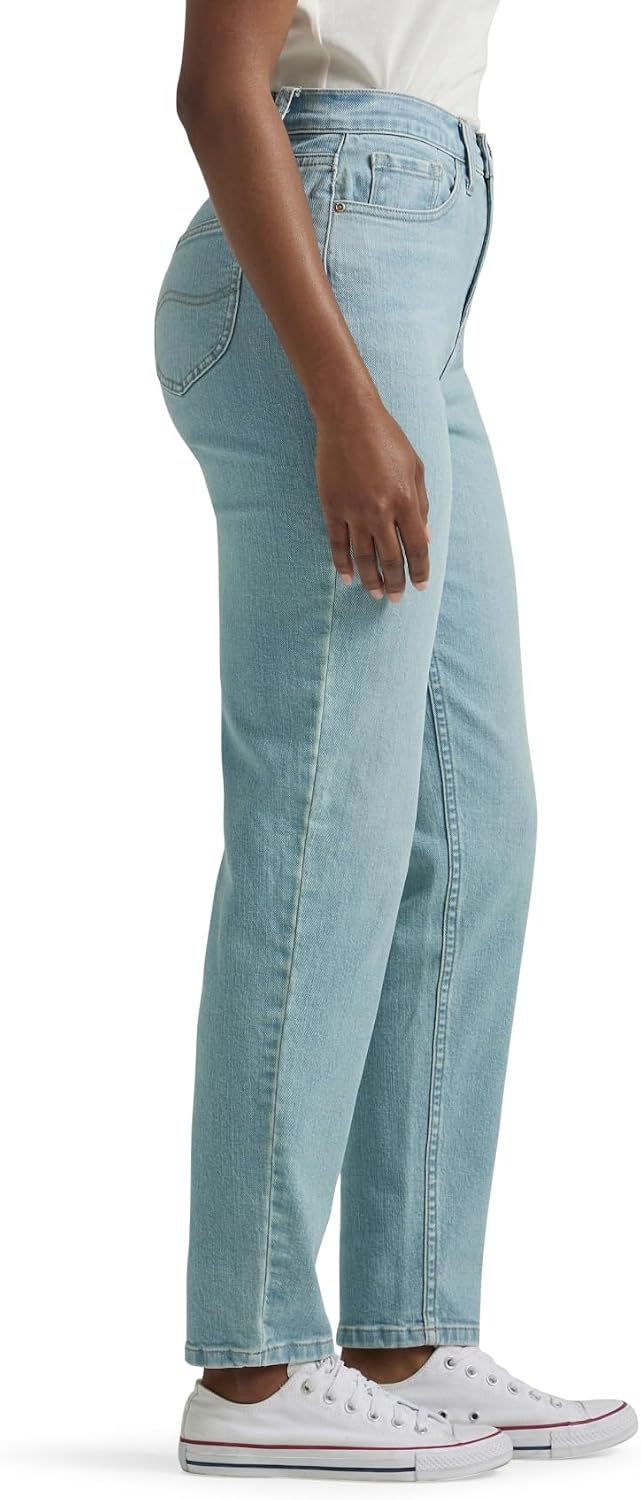
You know that moment when you pull on a pair of mom jeans in the dressing room and they look absolutely perfect — waist nipped, hip relaxed, leg falling just right — and then you take them home and they’re somehow completely wrong? That’s a proportion problem, not a style problem. Mom jeans and high-rise vintage fits (we’ll define these precisely in a moment) are the most proportion-sensitive silhouette in the denim wardrobe, which means getting them right requires understanding a handful of measurable details — rise height, seat ease, thigh taper, and leg opening — rather than just vibes and luck. This guide is built for the reader who already knows the category but is sitting with a decision: a specific pair under consideration, a return window closing, or a budget conversation with themselves about whether a $280 AGOLDE pair is genuinely different from a $98 entry-level option. It is. Here’s exactly how and why.
What “Mom Jean” Actually Means (and Where the Category Splits)
The term “mom jean” gets applied loosely to almost any high-rise, non-skinny denim, which is why it produces so many bad purchases. In practice, the category divides into three meaningfully different fits that behave differently on the body.
True mom jean: A waistband that sits at the natural waist (roughly 1–2 inches above the navel), a relaxed seat with 1–2 inches of ease beyond body measurement, a tapered or straight leg that narrows toward the ankle, and a rise of 11–13 inches from crotch seam to waistband top. Heddels’ anatomy guide describes this “natural-waist-plus-ease” construction as the defining structural signature of the silhouette, distinct from both the high-waisted skinny and the barrel jean. AGOLDE’s 90s Pinch Waist and the Lana Mid Rise Vintage from the same brand sit squarely here.
High-rise straight vintage: A similar waistband height but with a straighter, less tapered leg and slightly less seat ease — closer to a ’70s or ’80s workwear jean than a ’90s thrift-store find. Frame’s Le Original and Paige’s Cindy both operate in this space. These read as more formal and are more versatile as a trouser substitute.
Barrel / wide-leg vintage: Sometimes lumped with mom jeans but genuinely different — the leg widens below the hip rather than tapering or staying straight. Citizens of Humanity’s Gaucho and Rag & Bone’s Miramar live here. These are a separate proportion conversation and outside the scope of this guide.
Knowing which sub-category you’re evaluating changes every sizing and styling decision downstream. Most return grief comes from buying a high-rise straight when you wanted a true mom, or vice versa.
The Four Numbers That Decide Whether a Pair Works
Spec sheets — the measurement tables brands publish for each size — contain everything you need to pre-screen a fit before it arrives. Denimhunters’ guide to reading denim spec sheets recommends pulling four measurements: rise, seat, thigh, and leg opening. Here’s what each one tells you in practice.
Rise (front rise + back rise): Front rise runs from the center of the crotch seam to the top of the front waistband. Back rise does the same at the back. For a true mom jean, front rise typically lands at 11.5–13 inches in a size 28. Back rise in this category usually runs 1.5–2 inches longer than front — this is the “room-in-the-seat” signature. If a brand lists only one rise number, it’s almost always the front; factor in 1.5–2 inches for the back.
Seat: Measured across the widest point of the seat, doubled. A relaxed mom jean will show 2–3 inches of “positive ease” over your actual hip measurement. A pair with zero ease at the seat is a high-rise skinny in costume, and no amount of styling rescues it.
Thigh: Measured at the top of the inseam, doubled. The thigh-to-seat ratio determines whether the jean looks intentionally relaxed or accidentally baggy. In well-constructed mom jeans, the thigh measurement sits roughly 3–5 inches below the seat measurement (in circumference terms). When that gap closes — thigh almost equals seat — you lose the curved vintage silhouette and end up with a boxy slouch.
Leg opening: The circumference at the hem. Mom jeans typically land at 13–16 inches; high-rise straights push toward 15–17 inches. A tighter leg opening (13–14 inches) sharpens the tapered line and makes the hip contrast more pronounced. A wider opening (16–17 inches) reads more workwear-vintage. Vogue’s coverage of the high-rise denim revival notes that the leg opening is “the single measurement most responsible for decade-coding a silhouette” — smaller openings read ’90s, wider openings read ‘70s.
By the Numbers: Mom Jean Spec Benchmarks (Size 28 Reference)
| Measurement | True Mom Jean | High-Rise Straight |
|---|---|---|
| Front rise | 11.5 – 13 in | 11 – 12 in |
| Seat ease over body | +2 – 3 in | +1 – 2 in |
| Leg opening (circumference) | 13 – 15 in | 15 – 17 in |
| Waistband placement | Natural waist | High hip to natural waist |
Benchmarks compiled from published spec sheets; Who What Wear’s mom jean fit guide corroborates the seat-ease range as the primary differentiator across brands.
Where Budget Tiers Actually Diverge (And Where They Don’t)
If you’re comparing an $89 entry option to a $280 AGOLDE or a $420 Citizens of Humanity pair, the question isn’t whether the premium is real — it is — but where it shows up. Refinery29’s multi-tier mom jean comparison identifies three areas of genuine differentiation and one where the gap is smaller than marketing suggests.
Genuine gap #1 — Fabric. Entry-tier mom jeans (sub-$100) almost universally use stretch denim: 2–4% elastane blended with a cotton-poly mix. This creates a recovery problem. After a full day of wear, stretch denim at this weight (typically 9–10 oz) loses its shape at the knee and seat. The vintage-relaxed silhouette reads intentional for the first hour and tired by hour six. Mid-tier and premium pairs in this category more often use rigid or low-stretch denim (0–1% elastane, 11–13 oz), which holds its line throughout the day. AGOLDE’s 90s Pinch Waist is reviewed by owners across aggregated reviews as retaining its silhouette “from morning to evening without the knee-bag issue” — a direct consequence of fabric construction, not branding.
Genuine gap #2 — Waistband construction. Premium mom jeans typically feature a structured, interfaced waistband that sits flat without gaping at the back. Entry options frequently skimp here, and the result is the “waist gap” that plagues high-rise fits on anyone without a perfectly cylindrical torso. Harper’s Bazaar’s proportion-dressing coverage notes that waistband architecture is “invisible until it fails” — you don’t notice it when it works, but the back-gap problem is almost always a construction issue, not a body issue.
Genuine gap #3 — Inseam finish and hem weight. Higher-end pairs use chain-stitch hems and heavier selvedge fabric at the outseam, which affects how the leg drapes when you cuff. This matters most if you buy long and cuff to your preferred length, which is the recommended approach for any tapered mom jean: buy an inch longer than your inseam and roll once to set the proportion.
Smaller gap than expected — Rise accuracy. Across the mid-tier and premium segment ($150–$420), published rise measurements are generally reliable to within a quarter inch. The “this runs short in the rise” problem is more common at entry tier, where quality control on rise consistency is less rigorous. But a Paige Cindy is not meaningfully higher-rise than a Frame Le Original at the same nominal measurement — the difference is fabric and construction, not rise architecture.
Proportion Rules for Body-Specific Fit
Who What Wear’s mom jean guide and Harper’s Bazaar’s proportion dressing coverage converge on a framework that’s worth internalizing before you finalize any decision.
If you carry weight in the hip and thigh: The seat-ease spec is your friend, but the thigh measurement is where the fit can go wrong. Pull the thigh measurement from the spec sheet and compare it to your own thigh circumference plus one inch of ease. If the spec-sheet thigh is narrower than your measurement plus that inch, the jean will pull at the front crease and ruin the vintage line even if the waist fits. Size up and take in the waist if needed — or look for brands that offer a “curvy” or “high hip” variant, which adjusts the hip-to-waist differential without changing the rise.
If you’re petite (under 5’4”): A 12.5-inch front rise on a 5’8” frame reads as vintage high-rise; on a 5’2” frame it reads as an extreme super-high-rise that shortens the torso. Petite-specific cuts in this category — AGOLDE offers a petite option in several fits, and Citizens of Humanity runs dedicated petite sizing — typically reduce front rise to 10.5–11 inches and shorten the inseam proportionally. Do not buy a standard inseam and rely on hemming to fix this; hemming shortens the leg without adjusting the rise, and the silhouette reads bottom-heavy.
If you’re tall (5’10”+): Standard inseams in mom jeans (28–30 inches) frequently leave a cropped ankle on a tall frame, which can read either intentional or accidental depending on the leg opening. A narrower leg opening (13–14 inches) makes the crop look deliberate. A wider opening (16+) at a cropped length reads like the jean is simply too short. Either commit to the full ankle crop intentionally or size into a 32–34 inseam where the brand offers it. Frame and Paige both carry extended inseams in their vintage cuts, per published size range listings.
The Decision Framework: If X, Then Y
You’ve read the specs, you have a pair in mind. Here’s the decision tree.
If the seat ease is under 1 inch over your hip measurement: This is a high-rise skinny, not a mom jean. Return it or size up two sizes and plan to take in the waist.
If the fabric is over 2% elastane and you’re buying for day-to-night wear: Budget for mid-tier minimum ($150+). The entry-tier stretch denim will not hold the silhouette past lunch. The cost-per-wear math only favors a premium pair if you’re wearing it 80+ times; at that frequency, fabric integrity is the return on investment.
If you’re between sizes at the waist but the thigh is the limiting measurement: Size to the thigh. A tailor can take in a waistband for $20–$40. A tailor cannot add fabric to a thigh that’s already at capacity.
If the pair is at the $280–$420 price point and you’re hesitating: Run the cost-per-wear calculation at 100 wears (a realistic target for a well-constructed pair you genuinely love): a $300 jean is $3 per wear, a $90 jean replaced every 18 months due to shape loss is closer to $2.50 — but that math collapses the moment you account for styling losses and the wear-count you actually hit before the shape degrades. Owners in long-run reviews of AGOLDE and Citizens of Humanity pairs consistently note five-plus years of maintained silhouette. The entry-tier equivalent doesn’t reach that horizon.
If the rise is right and the thigh fits but the leg opening feels wrong: Hem and re-open. A clean raw hem or chain-stitch re-hem from a denim specialist (Self Edge offers this service, as do most Japanese denim retailers) lets you reset the leg opening to exactly the circumference you want without altering the rise or thigh. It’s the most underused tool in this category.
The mom jean silhouette rewards precision far more than it rewards luck. Pull the four numbers, benchmark them against your own measurements with one inch of ease, and match fabric construction to your actual wear frequency. When those three variables align, the proportion question answers itself.