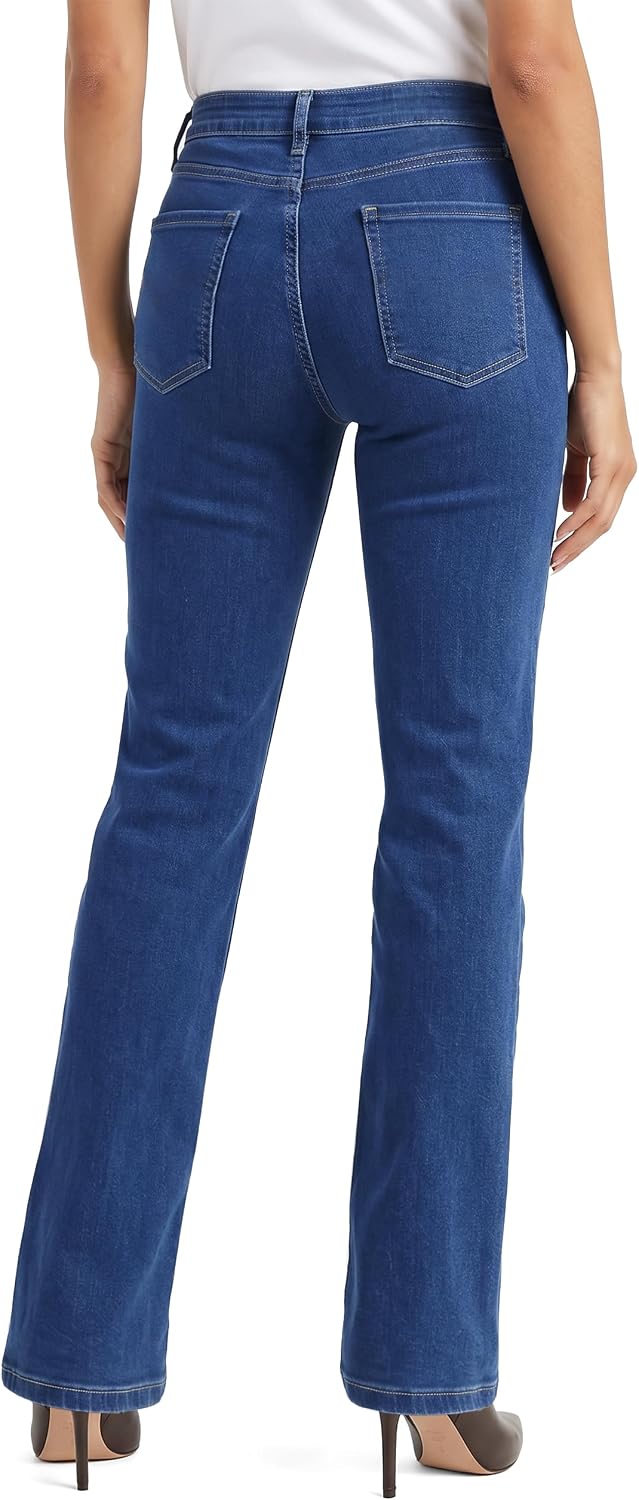
Here is the thing nobody tells you when you’re 5’10” standing in a dressing room: most jeans are cut for a 30-inch inseam (the measurement from your crotch seam straight down to the hem), and the entire women’s denim market quietly assumes that’s normal. An inseam is just the interior leg seam length — it determines whether the hem lands at your ankle, at your mid-shin, or in that sad no-man’s-land that reads as neither cropped nor full-length. If you need a 32-, 34-, or 36-inch inseam to get a clean break at the ankle or a proper floor-grazing flare, you already know the frustration: great fits in your waist size that look like capri pants the moment you button them. This guide is for women who have done enough shopping to understand why this problem is structural — not a personal sizing fluke — and who want a brand-by-brand decision framework, the actual numbers, and a clear rule for when to size up, hem down, or spend more.
Why the Tall Inseam Gap Exists (and Why It’s Getting Worse Before It Gets Better)
The core issue is economics, not indifference. As Business of Fashion’s coverage of denim supply chains notes, producing extended inseams requires mills to cut longer denim panels, which increases fabric waste per unit and complicates the grading process (grading = the mathematical scaling of a base size up or down across a size run). Brands selling at mass scale absorb that complexity only when demand is proven. The result is a market where 30” is the standard, 32” is offered selectively, and 34”–36” is treated as a specialty category even though women standing 5’9” and above — roughly 10–12% of American women, per CDC anthropometric data — routinely need it.
The secondary problem is stretch recovery. Many tall-specific pairs are cut in fabrics with a higher elastane content (elastane = the synthetic fiber, sold under brand names like Lycra, that gives denim its stretch) specifically to make the longer panels conform to varied leg shapes. That sounds like a solution, but Heddels’ explainer on selvedge and rigid denim construction notes that fabrics above roughly 3% elastane content tend to “bag out” at the knee and seat after a full day of wear — meaning your 34” inseam might look great at 9 a.m. and shapeless by noon. It’s a real tradeoff, and knowing it changes which brands are actually worth your money at each tier.
The Brand-by-Brand Inseam Reality: What Published Specs Actually Say
You can’t make a clean buying decision on inseam without understanding where each brand’s offering actually stops. Here’s where the main players land, based on published size guides as of May 2026:
By the numbers — maximum inseam offered by tier:
| Brand | Entry–Mid ($60–$150) | Mid–Premium ($150–$350) | Specialty / Heritage ($300+) |
|---|---|---|---|
| Madewell | 32” (selected styles) | 34” (tall-specific line) | 32” (selvedge line) |
| AGOLDE | 30–31” standard | 32” in select cuts | Not applicable |
| Frame | 31” standard | 32–34” in Le High Rise | Not applicable |
| Paige | 32” standard | 34” in Transcend Tall | Not applicable |
| Citizens of Humanity | 32” standard | 34” in Sloane/Zurie Tall | Not applicable |
| Rag & Bone | 31–32” standard | 34” on request / select fits | Not applicable |
| Oni Denim / Samurai Jeans | 33–34” standard (men’s heritage sizing available) | — | 34–36” via Self Edge custom hem |
Sources: published size guides from each brand’s website, cross-referenced against Who What Wear’s tall women’s denim roundup (2025) and Refinery29’s tall-girl buying guide.
A few things jump out immediately. First, the 34” ceiling is real — almost nobody in the mid-tier goes longer. Second, heritage selvedge brands like Oni Denim and Samurai Jeans actually offer more inseam length by default because they’ve historically sized from Japanese men’s cut standards, which run longer, and specialty retailers like Self Edge offer complimentary hemming from a longer base inseam. Third, AGOLDE — one of the most-recommended brands in reviews across Who What Wear and The Cut — effectively stops at 31-32” even in their most stretch-tolerant styles, which makes them a tough fit for anyone over 5’10” who wants a full-length silhouette.
The Tradeoffs You’re Actually Choosing Between
Once you know the inseam numbers, the real decision is about what you’re willing to give up. There are three meaningful tradeoffs in the tall-denim market right now.
Tradeoff 1: Inseam length vs. fabric quality
The brands that go to 34–36” most reliably are either entry-tier (where the extended sizing is achieved through stretch-heavy fabrics that reviewers consistently describe as “thin” and prone to wear at the inner thigh) or heritage selvedge (where the length comes from a longer raw panel, but the $350–$600 price point is non-negotiable). The mid-tier $150–$300 sweet spot — Frame, Paige, Citizens — offers 34” in specific styles only, and those styles tend to be the brand’s most elastane-forward fabric platforms. Paige’s Transcend fabric, for example, is specifically engineered for recovery in longer cuts; owners across aggregated Nordstrom and brand-site reviews consistently praise the all-day shape retention, but denim enthusiasts on Heddels’ forum threads note that Transcend’s ~92% cotton / 8% elastane blend doesn’t develop the character fades that lower-stretch fabrics produce over time. If fade potential matters to you, the tradeoff is real.
Tradeoff 2: Shopping tall-specific vs. hemming a longer base
A counterintuitive strategy that Denimhunters’ inseam measurement guide implicitly supports: buy a pair with a longer-than-needed base inseam in a fabric you love, then pay a tailor to hem to your exact length. A clean hem on a pair of premium denim runs $15–$30 at most independent tailors as of mid-2026. On a $250 pair of Frame Le High Rise Straight with a 34” inseam, you absorb that cost easily — and you get to specify whether you want a clean hem or a chain-stitch “roping” effect (roping = a slightly wavy hem that mimics the look of vintage selvedge denim, achieved by hemming on a single-needle chain-stitch machine rather than a standard lockstitch). Some tall-specific lines hem the garment before shipping in a way that makes re-hemming difficult or that shortens the inseam from the advertised measurement; Refinery29’s tall-girl denim guide specifically flags this as a known issue with certain direct-to-consumer brands that offer “tall” as a body-type checkbox rather than a genuine pattern alteration.
Tradeoff 3: Inseam vs. rise and seat proportion
This is the one most guides skip. A true tall-pattern alteration raises not just the inseam but the rise (the distance from the crotch seam to the waistband) and elongates the seat curve. A brand that simply cuts a longer inseam without adjusting the rise will produce a pair that fits in length but gaps at the back waist or pulls tight across the hip-to-knee run. Citizens of Humanity’s Sloane Tall and Zurie Tall are consistently cited by tall reviewers across Who What Wear’s 2025 roundup as brands that have genuinely re-graded the block (the master pattern template) for tall proportions rather than just extending the leg. Frame’s tall offerings receive more mixed reviews on the seat-to-rise relationship, with owners over 5’11” frequently noting a need to size up one in the waist to accommodate the hip curve — which then introduces a waistband gap. Worth knowing before you commit.
The Selvedge Option for Tall Women: Under-Discussed and Worth Considering
If you’re already shopping in the $300–$600 range, the heritage selvedge market has a structural advantage for tall women that almost no mainstream guide discusses: selvedge denim (denim woven on a narrow shuttle loom that produces a self-finished, non-fraying edge along the fabric’s length) is cut in longer base panels than stretch denim because it has no mechanical stretch to accommodate fit across varying leg lengths. That means a selvedge straight-leg or slim-taper from Oni Denim, samurai Jeans, or a custom-cut pair via Self Edge often starts at a 34” inseam as a default, not a premium upcharge.
The catch is fit architecture. Heritage selvedge brands traditionally cut from men’s Japanese body standards, which means the seat and thigh run slimmer and the rise runs lower than most women’s-specific denim. Heddels’ selvedge explainer and the community reviews at Self Edge’s editorial pages both note that women buying heritage men’s cuts typically need to size up one to two in the waist and budget for a tailor visit to take in the seat. That adds cost and friction — but for a pair that will fade beautifully over three to five years of wear and holds resale value at platforms like Grailed, the cost-per-wear math is genuinely favorable over a stretch-blend pair that pills and bags out in 18 months.
The Decision Rule: If X, Then Y
You’ve got the tradeoffs. Here’s how to actually use them:
If you need a 32” inseam and want the best fabric-to-price ratio: Citizens of Humanity Sloane Tall or Paige Transcend Tall at the $250–$320 range. Both offer legitimately re-graded patterns (not just longer legs) and receive consistent owner praise for shape retention through a full day. The stretch content is high, so don’t expect character fades — but you’ll have a pair that works.
If you need a 34” inseam and care about fabric quality: Buy a 34”+ base inseam in the best fabric you can afford (Frame Le High Rise in their non-stretch “natural” weight, or Citizens’ rigid-ish Sculpt options), then budget $20–$30 for a tailor hem at your exact length. You’ll get a better garment than any brand’s “tall” hem-at-factory option.
If you need a 34”+ inseam and you want something that gets better with age: Go selvedge through Self Edge or Blue in Green, size up one from your usual waist measurement, and commit to the tailor visit for seat and rise adjustment. The all-in cost — denim plus tailoring — lands around $400–$650 depending on the brand. Owners who have gone this route consistently report it as the last pair of this silhouette they needed to buy for years. That’s the cost-per-wear argument in a sentence.
If you’re between strategies: The 32” hemming play is almost always better than buying a tall-specific pair in a fabric you’re indifferent about. Fabric is harder to fix than length.
The tall inseam problem isn’t solved at the industry level — yet. But it’s navigable with the right framework, and the options in 2026 are meaningfully better than they were five years ago. The brands that have genuinely re-graded for tall proportions are worth the price premium; the ones that just pulled the hem down aren’t.