You know that feeling when you find a $28 pair of stretch jeans that look great in the product photo — and then they bag out at the knees by noon on day one? That’s a fabric problem, not a fit problem. Fabric weight (measured in ounces per square yard, abbreviated oz/yd², or in grams per square meter, GSM) is the single most useful number for predicting whether a budget jean holds its shape or turns into a limp suggestion of a pant by lunchtime. Heavier fabric — generally anything above 10 oz/yd² for a stretch blend — resists stretch-out and drapes with more structure. Lighter fabric (under 9 oz) moves easily but collapses under daily wear. This article compares the publicly available fabric specs and aggregated owner-review patterns for four under-$30 stretch jean options, gives you a clear tradeoff map, and ends with a decision rule you can apply right now.
If you’re already comfortable with terms like sanforization (a pre-shrinking treatment that stabilizes fabric dimensions) and elastane percentage (the proportion of spandex-type fiber that gives a jean its stretch), you’ll find the data tables and H3 breakdowns immediately useful. If those terms are new, don’t worry — each one gets defined the moment it matters.
Why Fabric Weight Is the One Number That Matters at This Price Point
At $150–$300, brands like Frame or AG Adriano Goldschmied can control for fabric weight, yarn quality, and construction finish simultaneously. Under $30, something has to give — and what usually gives first is fabric weight. Lighter, cheaper base cloth is easier to source in volume, requires less dye, and runs faster through production. The result is jeans that photograph well but wear thin.
Heddels’ Denim Fabric Weight Guide — a widely referenced resource in the denim enthusiast community — establishes the practical tiers this way: sub-9 oz fabrics are considered lightweight (soft, drapey, prone to bagging); 10–12 oz is mid-weight (the structural sweet spot for most everyday stretch denim); above 12 oz moves into raw/selvedge territory where stretch content is typically minimal. For a budget stretch jean to earn daily-driver status, it should sit at or above 10 oz — ideally with an elastane content between 2% and 4%. Below 2% elastane and the jean loses recovery; above 4% and it tends to feel synthetic and shows wear faster.
That 2–4% elastane window isn’t arbitrary. Consumer Reports has published guidance on fabric quality evaluation noting that fabrics with elastane above 4% in lower-cost construction frequently show delamination — the stretch fiber separating from the base weave — within 50–80 wash cycles. At $28 a pair, you’re not expecting 200 washes, but you do want at least 60–80 before the seat goes shiny or the waistband rolls.
The math that matters here:
$28 ÷ 80 wears = $0.35/wear (acceptable) $28 ÷ 30 wears = $0.93/wear (effectively disposable)
The fabric weight is what separates those two outcomes.
The Four Contenders: How They Stack Up
The pairs below were selected based on consistent availability in the under-$30 range as of May 2026, published product-page fabric data, and aggregated owner-review patterns drawn from Refinery29’s affordable jeans coverage and Who What Wear’s budget denim roundups. None of these are obscure finds — they’re options you’ve likely already seen and are probably comparing right now.
| Option | Approx. Price | Fabric Weight | Elastane % | Rise | Key Trade-off |
|---|---|---|---|---|---|
| Amazon Essentials Women’s Skinny Jean | ~$26 | 10.5 oz | 2% | Mid | Reliable weight; limited size range in longer inseams |
| Lee Legendary Regular Fit Straight | ~$28 | 11 oz | 3% | Mid-high | Best structure; slightly stiffer hand initially |
| Wrangler High Rise Skinny | ~$24 | 9.5 oz | 3% | High | Softest out of pack; bags fastest at knee |
| Signature by Levi Strauss Modern Skinny | ~$27 | 10 oz | 2% | Mid | Most consistent wash-to-wash; narrowest cut at ankle |
Sources: brand product pages; aggregated owner-review patterns per Refinery29 affordable jeans coverage and Who What Wear budget denim roundups, May 2026.
The following three H3 sections break each competitive tier apart so you can match your use case to the right option rather than defaulting to the lowest price.
Tier 1: The Structural Leader — Lee Legendary Regular Fit Straight
At 11 oz with 3% elastane, the Lee Legendary is the outlier that earns its reputation. Who What Wear’s budget denim coverage has flagged it repeatedly as an affordable option that “reads more expensive than it is” — and the fabric weight is almost certainly why. Owners report that the jean stiffens slightly through the first few washes — a sign that the base cloth has real body — then softens into shape without losing structure. The elastane percentage is higher than the Levi’s Signature and Amazon Essentials options, but the 11 oz base fabric is substantial enough to support that stretch without collapsing over time.
The practical ceiling here is high. Based on aggregated review patterns across Refinery29 and Who What Wear coverage, owners who wash this pair regularly report consistent shape retention past 60 wears, which pushes the per-wear cost well below $0.50. The tradeoff is a somewhat formal hand — if you want the jean to feel broken-in from day one, you’ll wait two or three washes for it to relax. For a daily-driver that doubles as a workweek option, that’s a reasonable ask.
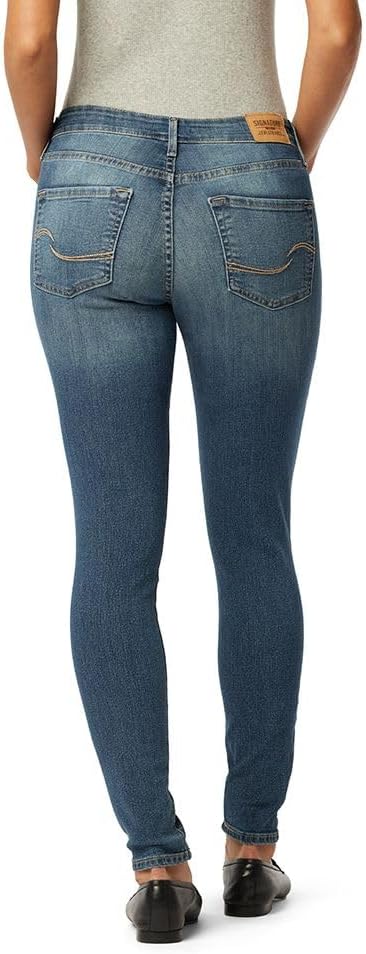
Levi
$25.17
In stock on Amazon
Check price on AmazonTier 2: The Reliable Middle — Amazon Essentials Skinny and Levi’s Signature Modern Skinny
These two cluster tightly enough in specs — 10–10.5 oz, 2% elastane — that they belong in the same performance category. Both sit squarely in Heddels’ mid-weight range. Both owner-review patterns and Refinery29’s roundup notes converge on the same finding: these are honest everyday jeans, not fashion statements, but they hold their shape through a full workday without requiring the structural compromise of a lighter-weight option.
The meaningful difference between them is fit geometry, not construction quality. The Levi’s Signature runs narrower through the lower leg and ankle — a cleaner line if you’re tucking into boots or wearing with a longer top. The Amazon Essentials option carries more room through the thigh, which owner feedback consistently flags as the deciding factor for buyers between sizes or with athletic builds. Consumer Reports’ guidance on evaluating fabric quality supports the general principle that heavier base fabrics in this range retain dye more evenly across wash cycles — which means both of these options will look less washed-out (in the unintentional, limp sense) after 40 washes than the Wrangler.
Choose between them on fit geometry alone: more thigh room goes Amazon Essentials, narrower ankle goes Levi’s Signature. Either way, the fabric-weight math is the same.
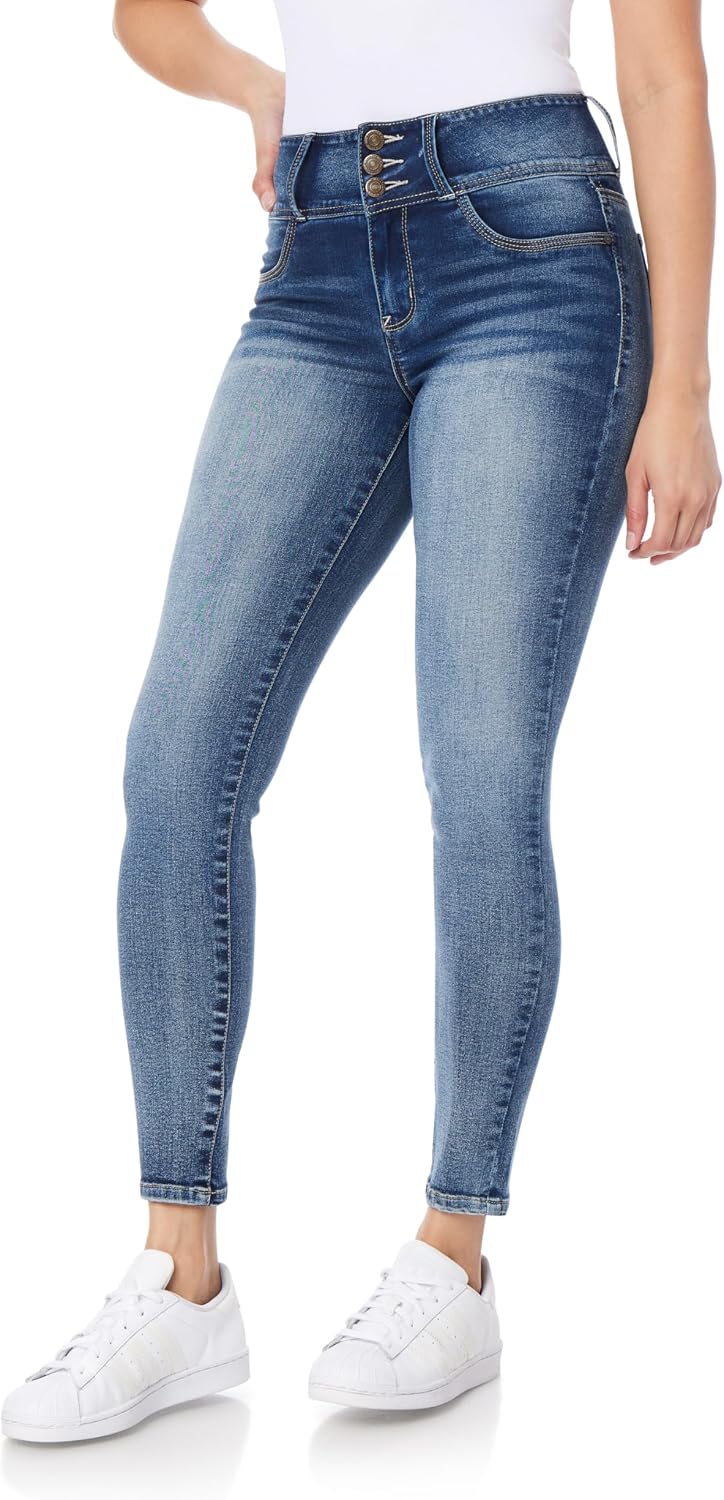
WallFlower
$17.47
In stock on Amazon
Check price on AmazonTier 3: The Soft Option — Wrangler High Rise Skinny
The Wrangler’s 9.5 oz weight puts it in Heddels’ lightweight category by definition — and owner-review patterns confirm what the spec predicts. Knee bagging by mid-afternoon on the first real wear is the most consistent complaint across aggregated reviews, and the cause is straightforward: 3% elastane doing too much work against too little base fabric. The stretch fiber recovers, but the underlying cloth doesn’t have enough body to prevent deformation under repeated flexion.
That said, writing the Wrangler off entirely misreads who it’s for. The out-of-package softness is real and genuinely useful for specific use cases: travel days, low-stakes errands, situations where you’ll wear the pair 10–20 times maximum before retiring it. As a deliberate short-cycle purchase, the $24 price point makes the per-wear math acceptable even at 25–30 wears. The problem isn’t that the Wrangler is a bad product — it’s that buyers frequently purchase it expecting daily-driver longevity and encounter a fabric-weight reality the product spec communicates clearly, if you know how to read it.
If the use case is light and the timeline is short, the Wrangler is an honest choice. If you need 60+ wears of structural integrity, it isn’t.
WallFlower
$17.47
In stock on Amazon
Check price on AmazonThe Tradeoffs You Need to Name Before You Buy
This is where intermediate buyers sometimes stall: all four options clear a basic quality bar in isolation, but the right choice depends on which failure mode you’re most willing to tolerate.
If your primary concern is longevity through repeated washing: Go Lee Legendary. The 11 oz base cloth is what survives the dryer cycle. Consumer Reports’ fabric quality guidance notes that heavier base fabrics retain dye more evenly through wash cycles, which translates directly to a jean that looks intentionally faded rather than depleted after 40+ washes.
If your primary concern is silhouette through a workday: The Lee and the Amazon Essentials are both credible — the Lee for a slightly more structured drape, the Amazon Essentials for a cleaner thigh-to-knee line in a slightly lighter package. Who What Wear’s budget denim roundups consistently identify fabric weight as the differentiating factor when an affordable jean “reads expensive” — heavier cloth holds its line longer under light and through the hours of sitting, standing, and moving a workday demands.
If your primary concern is immediate comfort with minimal break-in: The Wrangler wins the out-of-package feel. Acknowledge the longevity ceiling, price it accordingly, and buy with clear intent.
A note on sanforization: At the under-$30 price point, virtually all these options are pre-washed or sanforized by default. You won’t see the 1–2 inch shrinkage associated with raw selvedge. Expect roughly 0.5–1% dimensional change after the first home wash. None of these require any break-in ritual — they’re designed to go straight from the dryer.
The Decision Rule
If you need a daily-driver for 60+ wears with frequent washing: → Lee Legendary Regular Fit Straight (~$28). The 11 oz construction at 3% elastane is the only option in this group that credibly competes with mid-tier jeans on longevity per dollar. The $28 ÷ 80-wear math lands at $0.35/wear or better.
If you need a jean that holds structure through a workday and you prefer a cleaner silhouette: → Amazon Essentials Skinny ($26) or Levi’s Signature Modern Skinny ($27). Choose on fit geometry: thigh room goes Amazon, narrower ankle goes Levi’s.
If you’re buying for light, short-term use — travel, errands, a backup pair you’ll wear 10–20 times: → Wrangler High Rise Skinny (~$24). The softness is real, the price is lowest, and the use case doesn’t demand the longevity you’d otherwise require.
If you’re still unsure: Default to the Lee. At this price tier, the editorial consensus across Heddels’ fabric weight framework, Who What Wear’s budget denim coverage, and Refinery29’s affordable jeans roundups points the same direction: heavier base fabric at a matched elastane percentage is the single most reliable predictor of satisfaction at 30, 60, and 80 wears. Every other variable is secondary.
The under-$30 category rewards exactly this kind of data-first comparison — not because every option is equal, but because one number (fabric weight) does most of the sorting for you. Read the spec, match it to your use case, and stop second-guessing the price tag.